
Icons of Collapse.
We built our myths from things designed to disappear.
Now they are outliving us.
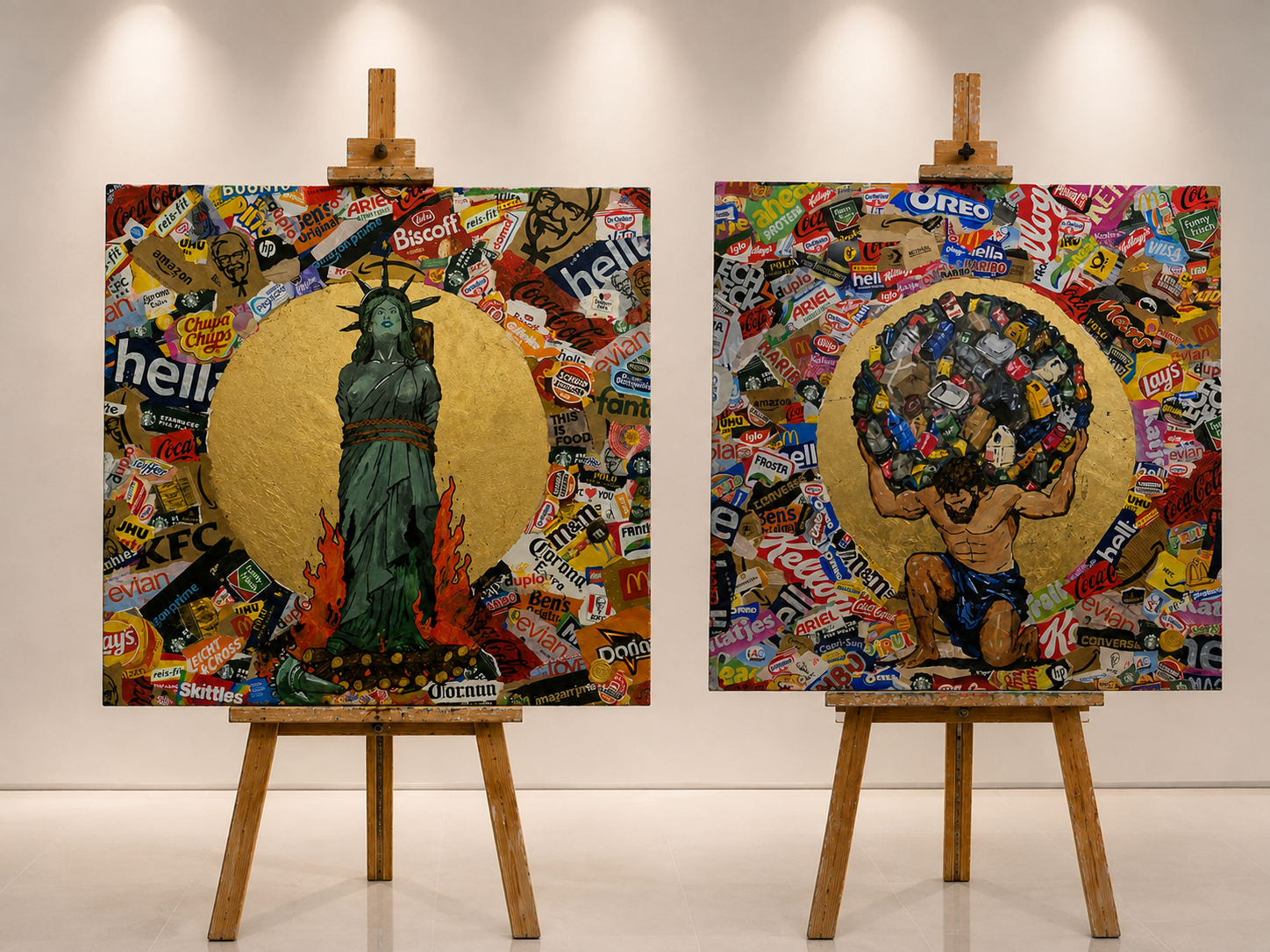
Icons of Collapse examines the contradictions at the heart of contemporary consumer culture: our desire for more, our dependence on symbols, and our remarkable ability to turn almost anything into an object of worship.

At the centre of each work stands a familiar cultural icon — removed from its original mythology and placed into a new one. Figures associated with freedom, power, progress or collective belief become protagonists in scenes of transformation, contradiction and collapse.

Surrounding them are the physical remains of consumption. Real packaging, once designed to attract attention and trigger desire, is torn apart and rebuilt into dense visual landscapes. Coca-Cola, Pringles, candy wrappers and countless other fragments cease to function as advertising and become archaeological material — evidence of a civilization telling its story through what it consumes and leaves behind.

Gold leaf introduces another layer of contradiction. For centuries, gold has marked the sacred: icons, altarpieces, power and permanence. Here it meets disposable plastic and mass-produced packaging. The precious and the worthless occupy the same surface, questioning who decides what deserves to be preserved and what is destined to become waste.

This tension runs through the entire series. Beauty meets destruction. Sacred imagery collides with commercial language. Cultural ideals confront the material consequences of the culture that created them.

The works are not predictions of some distant dystopia. Their collapse is already present — hidden beneath bright colours, familiar logos and the seductive surfaces of everyday life. And yet, destruction is never the only possibility. By taking what has lost its purpose and giving it another, the works themselves become acts of transformation.

Icons of Collapse does not reject consumer culture from the outside. It is made from its remains, fascinated by its imagery and implicated in its contradictions. The question is therefore not simply what our culture destroys.

It is what we choose to worship, what we choose to discard — and what the remains will say about us when we are gone.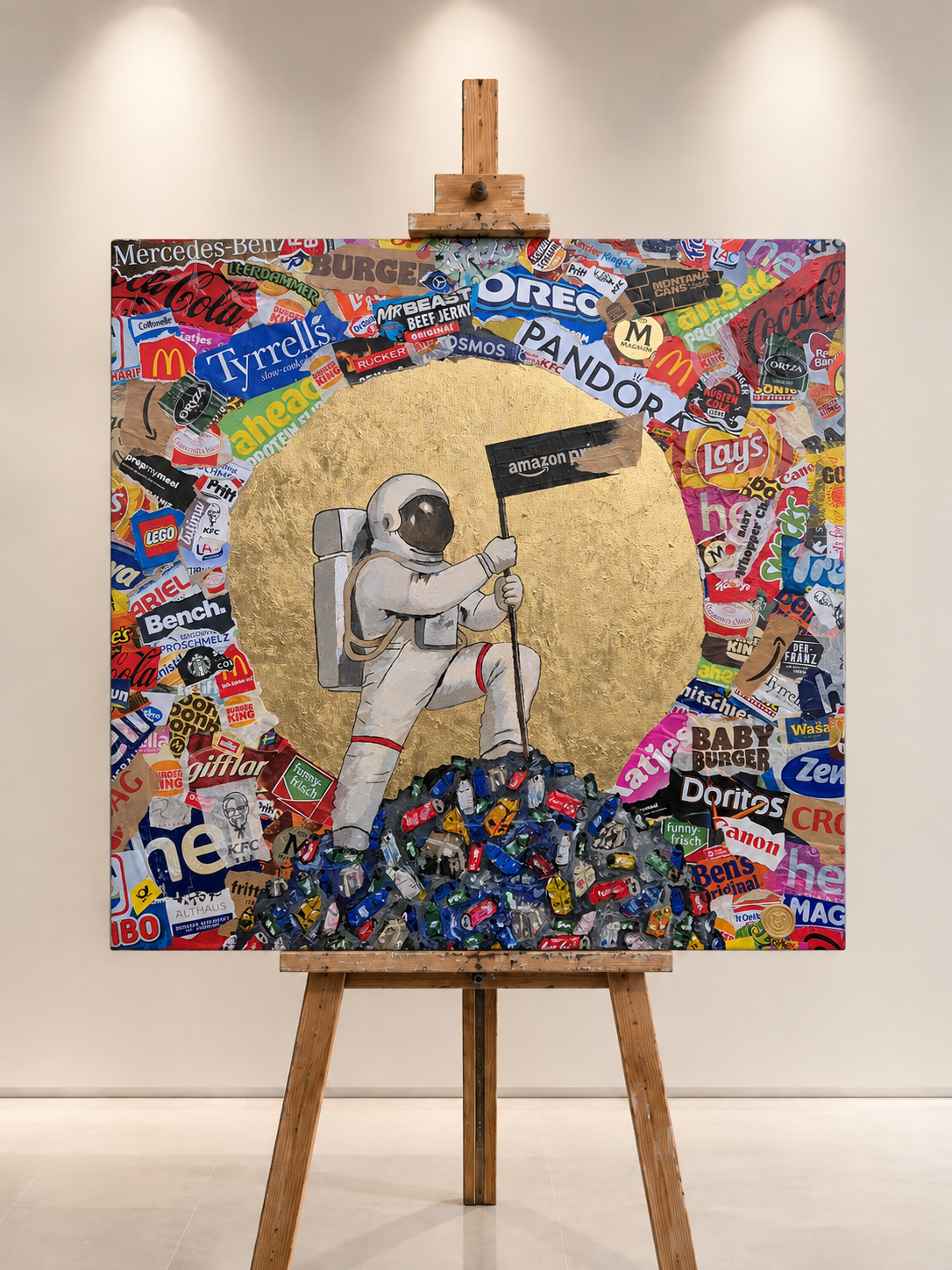
What if reaching a new world only means bringing the old one with us?
New Frontier is the third work in Icons of Collapse, a series exploring how consumer culture shapes our myths, identities and sense of value.
At its center stands an astronaut.
For generations, the astronaut has embodied one of humanity’s most powerful ideas of progress: exploration, discovery and the possibility of going beyond the limits of the world we already know.
In New Frontier, he has made it.
He stands on another planet.
But he did not arrive alone.
We brought everything with us.
Beneath his feet lies a landscape already covered in the remains of consumption — bottles, containers and discarded objects accumulating on a world that was supposed to represent a new beginning.
And instead of planting the flag of a nation, the astronaut raises another familiar symbol.
The gesture echoes one of the defining images of human exploration — planting a flag on newly reached territory. But here, discovery and consumption have become almost impossible to separate.
A new world becomes a new market.
A new frontier becomes a new destination.
And progress carries its waste with it.
The discarded packaging surrounding the astronaut is not merely painted or represented. It physically enters the work: real fragments of consumer culture transformed into the landscape of humanity’s imagined future.
Behind him, the recurring golden circle of Icons of Collapse gives the astronaut the appearance of a contemporary icon. Gold — historically associated with permanence, divinity and objects worthy of preservation — meets materials created to be consumed and discarded almost immediately.
The contradiction is deliberate.
Because New Frontier is not really about space.
It is about the belief that somewhere else will save us from what we refuse to change here.
Human history is filled with frontiers — new territories, new technologies, new markets, new promises of abundance. Again and again, progress offers the possibility of beginning differently.
But what happens if our habits travel faster than our ideals?
The astronaut has reached the future.
The waste is already there.
As the third chapter of Icons of Collapse, New Frontier expands the series beyond the world we inhabit today.
Where Self Destruct questions what happens when our ideals begin to consume themselves, and Overload confronts the growing weight of what our progress leaves behind, New Frontier asks whether escape is possible without transformation.
Perhaps humanity will one day reach another world.
The more uncomfortable question is:
Will we discover something new — or simply find another place to consume?
NEW FRONTIER
Icons of Collapse · No. 3
2026
Original artwork · Unique work (1/1)
Acrylic, discarded packaging & metal leaf on canvas
Canvas on wooden stretcher frame
80 × 80 × 4 cm
31.5 × 31.5 × 1.6 in
How much can we carry before progress becomes a burden?
Overload is the second work in Icons of Collapse, a series exploring how consumer culture shapes our myths, identities and sense of value.
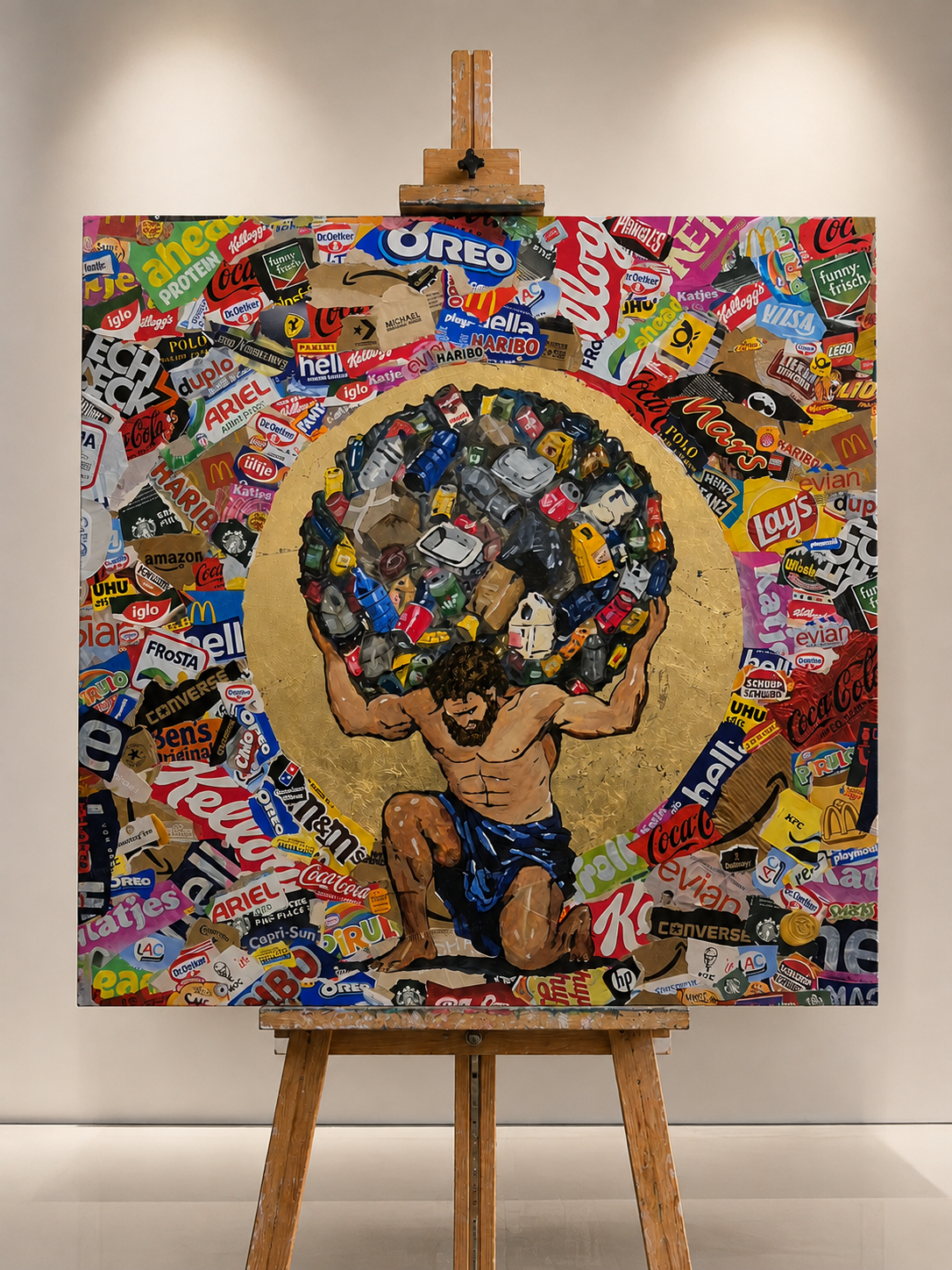
At its center stands Atlas.
For centuries, he has been depicted carrying the heavens on his shoulders — an enduring symbol of strength, responsibility and impossible burden.
But in Overload, Atlas no longer carries the world.
He carries what we have made of it.
Above him rises an enormous sphere of discarded packaging: boxes, labels, wrappers and fragments of everyday consumption compressed into a new kind of planet.
Atlas is still holding it.
But he is on his knees.
The distinction matters.
Overload is not simply an image of collapse. It captures the moment before it — that uncomfortable point at which the weight has become almost unbearable, yet somehow we continue to carry it.
More products.
More convenience.
More choice.
More consumption.
And inevitably: more remains.
The materials surrounding Atlas are not representations of waste. They are waste — fragments of objects designed, purchased, opened and discarded, now physically transformed into the world he is forced to carry.
Behind him, the recurring golden circle of Icons of Collapse gives the scene an almost sacred quality. Gold traditionally represents permanence, value and transcendence. Here, it exists alongside materials whose intended lifespan may have been measured in days or even minutes.
That contradiction raises a simple question:
When did having more become carrying more?
As the second chapter of Icons of Collapse, Overload continues the conversation begun by Self Destruct.
Where Self Destruct confronts the erosion of the ideals we once built to endure, Overload turns toward the consequences of the world we have built around them.
But Atlas has not fallen.
Not yet.
Perhaps he will collapse beneath the weight.
Perhaps he will find a way to put it down.
Or perhaps we will simply add one more thing.
OVERLOAD
Icons of Collapse · No. 2
2026
Original artwork · Unique work (1/1)
Acrylic, discarded packaging & metal leaf on canvas
Canvas on wooden stretcher frame
80 × 80 × 4 cm
31.5 × 31.5 × 1.6 in
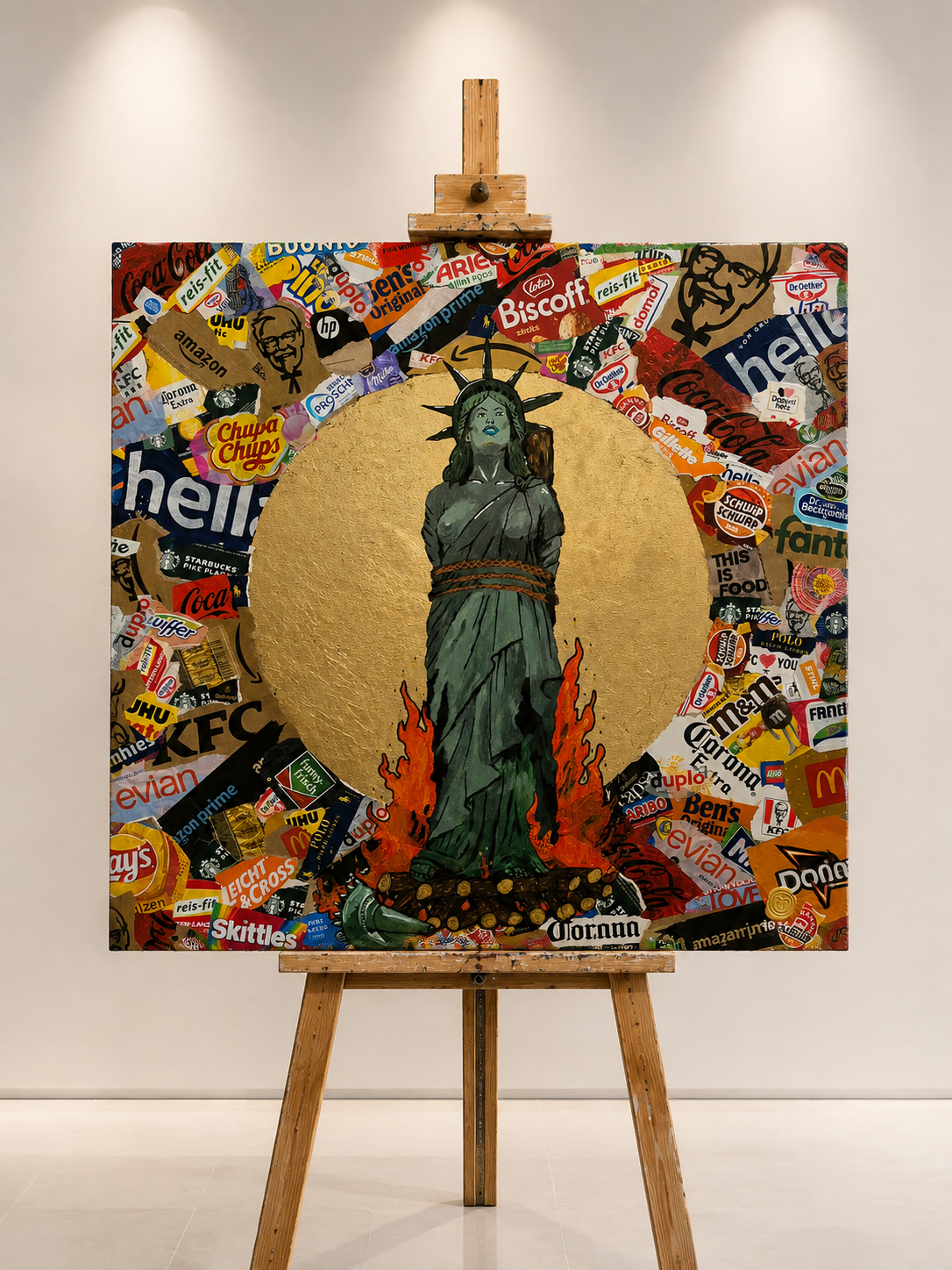
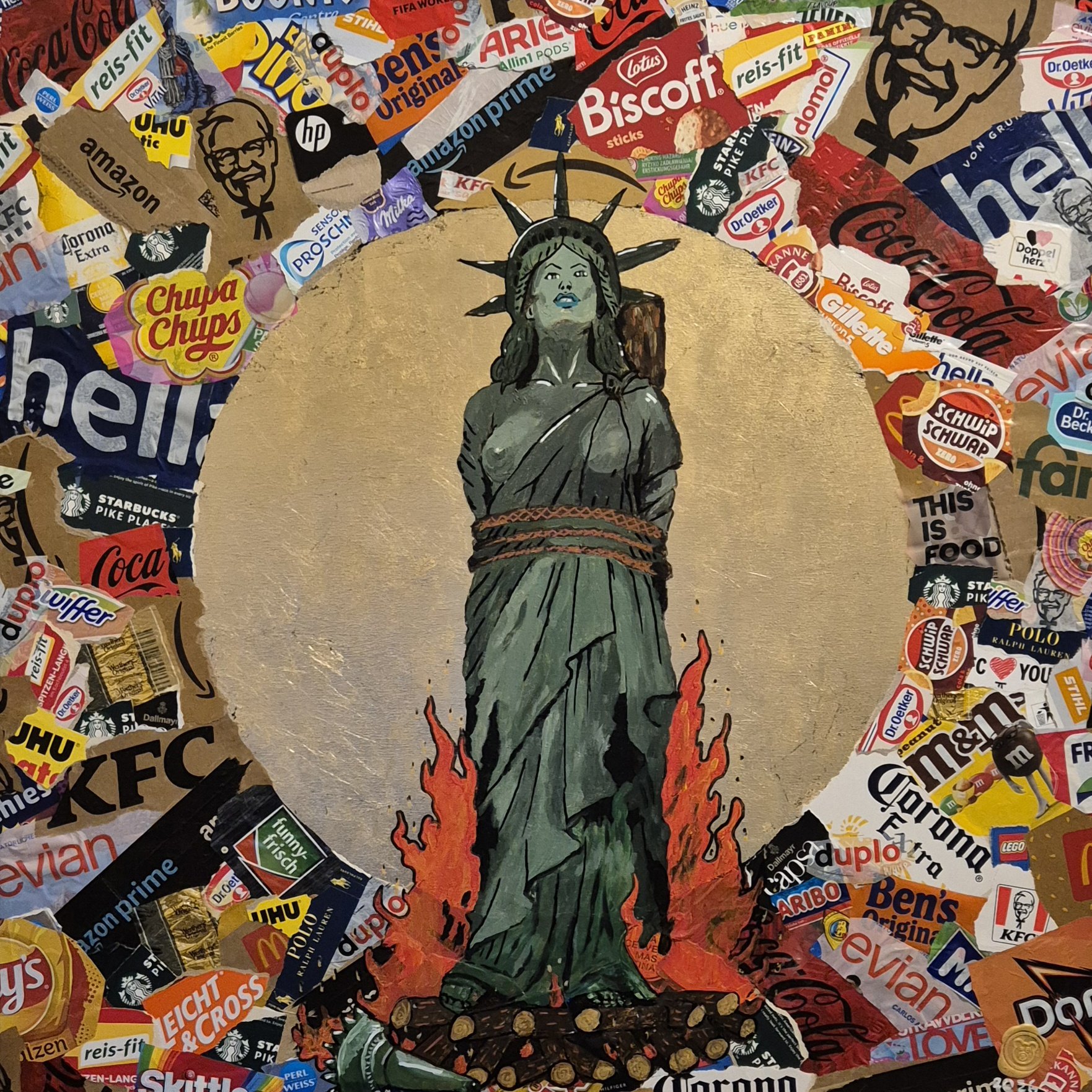
What happens when the things we create begin to consume the things we believe in?
Self Destruct is the first work in Icons of Collapse, a series exploring how consumer culture shapes our myths, identities and sense of value.
At its center stands the Statue of Liberty.
Confident. Upright. Almost defiant.
Yet she is standing on a burning pyre.
Around her, fragments of real consumer packaging form a chaotic landscape of brands, promises and discarded desires. Packaging designed to be opened, consumed and thrown away surrounds a monument designed to endure.
That contradiction lies at the heart of Self Destruct.
We surround ourselves with things that were never meant to last — while slowly sacrificing the things we once believed were eternal.
Behind Liberty, a circle of gold elevates her almost like a contemporary saint. But the surrounding debris tells a different story.
What do we actually worship today?
Our ideals — or the endless cycle of wanting, buying, consuming and replacing?
The fire offers no simple answer.
It can mean destruction.
But fire can also mean purification and transformation.
And Liberty is still standing.
Icons of Collapse places familiar symbols of civilization inside the contradictions of contemporary life. The series is not simply about waste. It asks what happens when progress, consumption and desire begin to redefine what we consider valuable — and what we are willing to leave behind.
Perhaps Self Destruct isn't really asking what is happening to Liberty.
Perhaps it is asking what is happening to us.
SELF DESTRUCT
Icons of Collapse · No. 1
2026
Original artwork · Unique work (1/1)
Acrylic, discarded packaging & metal leaf on canvas
Canvas on wooden stretcher frame
80 × 80 × 4 cm
31.5 × 31.5 × 1.6 in