
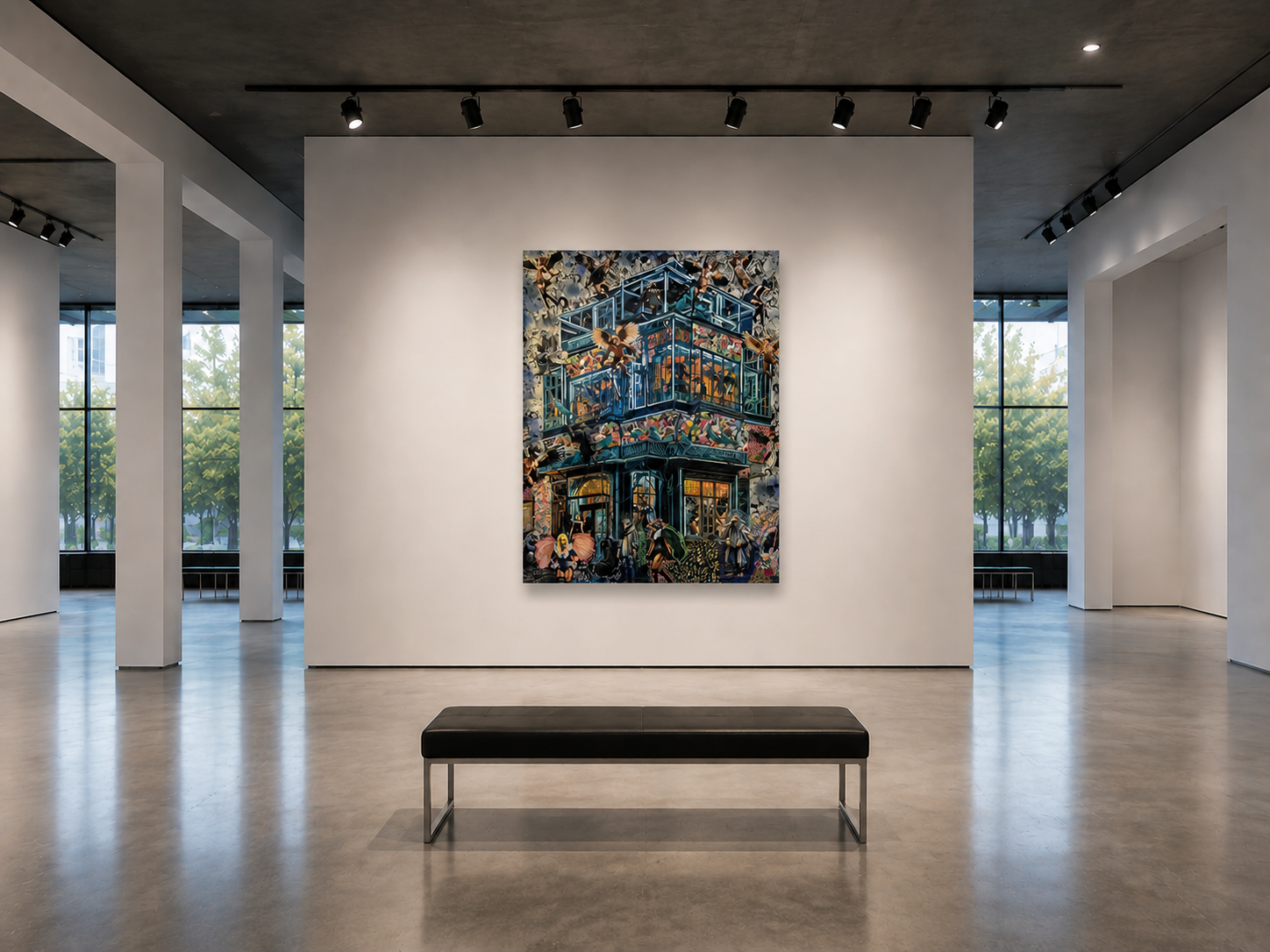
The Vögelhaus.
Freedom looks different from inside the cage.
The Vögelhaus begins with a simple contradiction: a bird is one of our oldest symbols of freedom — yet birds are also creatures we put in cages.

From there, the work unfolds into a surreal world in which the boundaries between freedom and captivity become increasingly difficult to locate. Birds, cages and displaced figures inhabit a reality where familiar symbols no longer behave as expected. What appears playful at first gradually becomes uncertain.The work is less interested in captivity itself than in the moment we stop recognizing it.We build structures around our lives — social conventions, expectations, routines and systems that offer comfort, identity and belonging. Some protect us. Some restrict us. Most do both. Over time, the boundaries we once noticed can become so familiar that they simply become part of the landscape.This ambiguity runs throughout The Vögelhaus. Freedom and confinement are not presented as opposites, but as states that can quietly transform into one another. A cage can provide safety. An open door does not guarantee escape. And someone who has adapted perfectly to their surroundings may no longer feel trapped at all.The surreal imagery deliberately refuses to resolve these contradictions. Instead, it leaves the viewer somewhere between humour and unease, invited to decide where the boundaries really are — and whether they exist outside the work as well.Maybe freedom is not the absence of cages. Maybe it begins with noticing them.
Mixed Media on Canvas, 2025
One-of-a-kind Artwork
Size: 120 × 154 × 4 cm | 47.2’’ x 60.6’’ x 1.6’’
The Vögelhaus is a surreal, layered mixed media composition that immerses viewers in a vibrant, chaotic tableau where fantasy and social commentary collide. The work depicts a neon-lit brothel constructed like a giant birdhouse—its luminous architecture rendered in electric blues and translucent layers, glowing against a dense collage background. This structure teems with human-bird chimeras in provocative, theatrical stances: perched on ledges, flying through the skies, or framed in glowing windows.
The imagery flutters between earthly desire and mythical symbolism. Wings, feathers, masks, and animalistic gestures mix with voyeuristic glimpses into the interior. Layers of pop culture ephemera, graffiti, and classical references encrust the scene, creating a dreamlike texture.
At its core, The Vögelhaus is a visual paradox—a fusion of freedom and captivity. The title, meaning “The Birdhouse,” evokes both shelter and entrapment. Birds, symbols of freedom, grace, and transcendence, are here also caged or performing. The chimeric figures seem part wild, part commodified—caught between worlds.
The artwork probes the tension between "being free and doing what you want" and the stark reality of sex work within confined systems. It challenges the romantic ideal of being “free like a bird,” presenting characters adorned with feathers but bound by invisible chains—social, psychological, or economic. This duality invites reflection on what freedom truly means when desire, performance, and survival intertwine.
Materials include:
925 silver, Swarovski elements, goose feathers, paper collage (notably manga), acrylic, spray paint, and pastel chalk.
Meticulously rendered details extend along the 4 cm | 1.6’’ canvas edges, creating a fully immersive, three-dimensional object. A wax seal signature in the lower right-hand corner serves as a tactile mark of authenticity.