
 Image 1 of 2
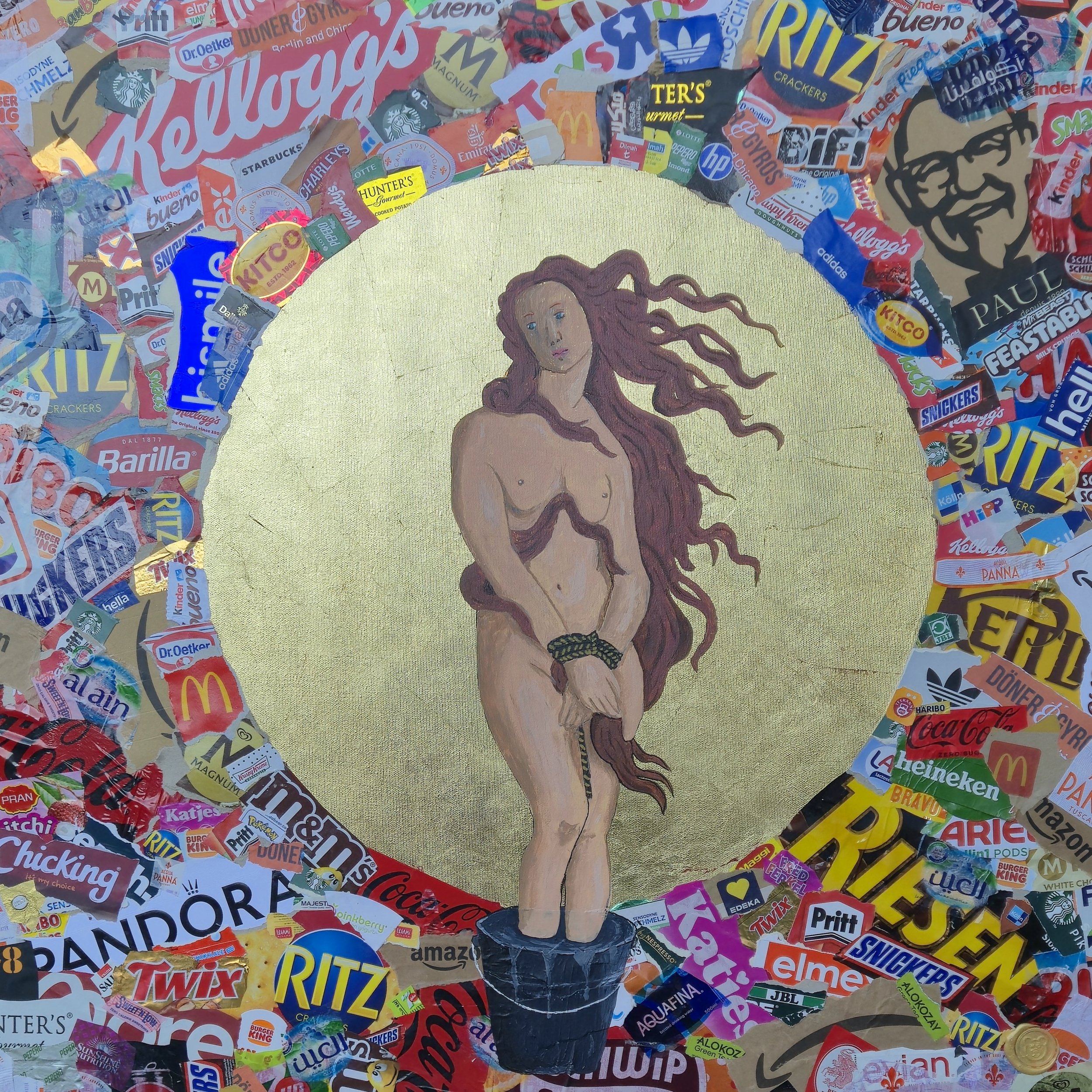 Image 2 of 2
What happens when the goddess of beauty can no longer escape the world that worships her?
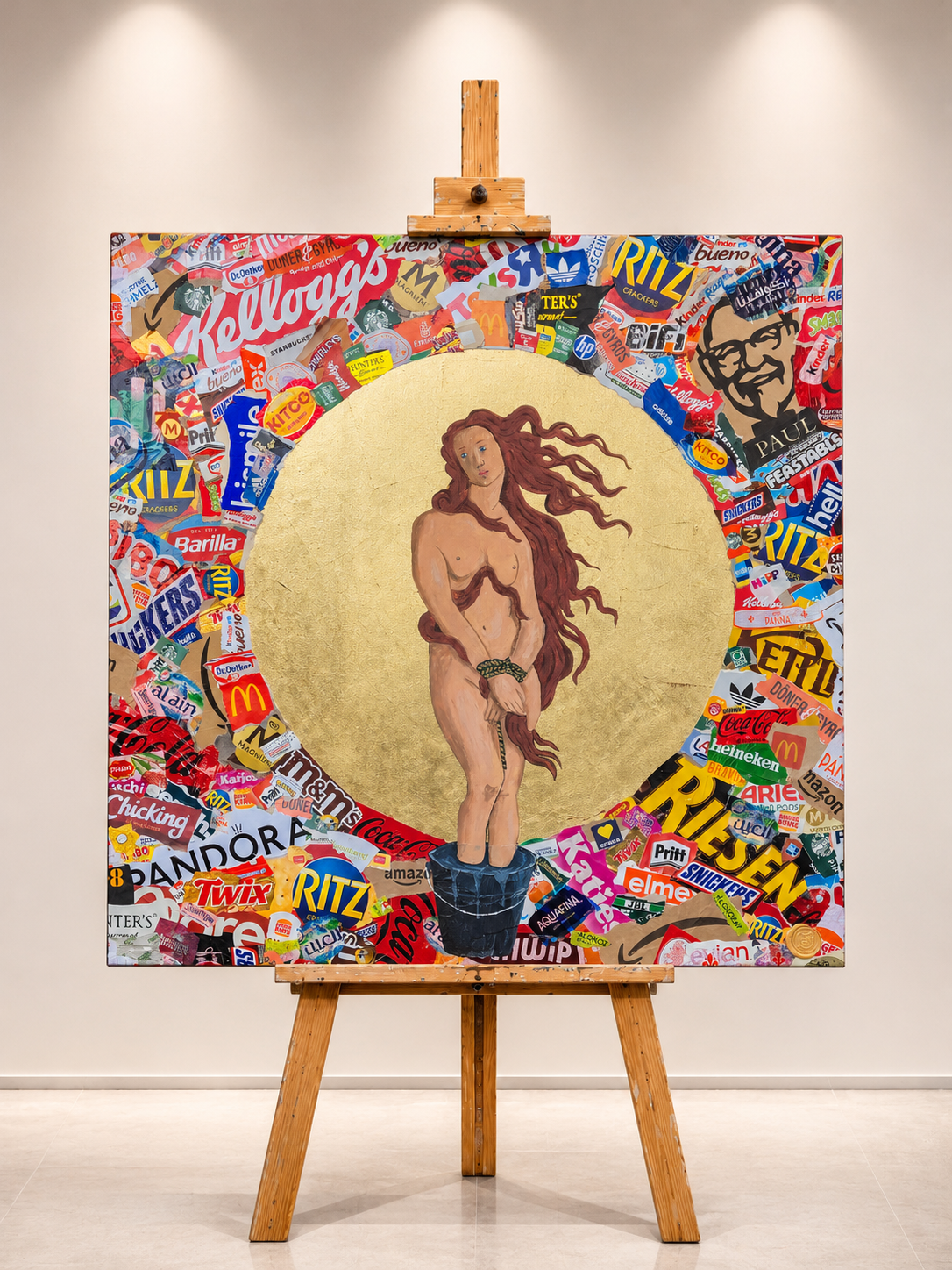
Back to the Sea! is the fifth work in Icons of Collapse, a series exploring how consumer culture shapes our myths, identities and sense of value.
At its center stands one of the most enduring symbols of beauty in art history.
Venus.
In Botticelli's The Birth of Venus, the goddess emerges from the sea, carried toward the shore by the wind. Naked, vulnerable and untouched by the world she is about to enter.
It is an image of arrival.
Of beauty entering existence.
Of a beginning.
In Back to the Sea!, Venus stands before us once again.
But something has changed.
She is no longer arriving. She may be leaving.
Her wrists are bound. Her feet are trapped in a bucket of concrete. The flowing hair that once symbolized freedom and movement now surrounds a figure unable to move.
The goddess of beauty has become a prisoner.
And the world around her is no longer the untouched landscape of the Renaissance.
It is a world drowning in consumption.
The discarded packaging surrounding Venus represents the endless cycle of products, promises and desires that define contemporary life. Real fragments of consumer culture physically embedded in the artwork, confronting an ancient ideal of beauty with the disposable reality of our time.
Behind her, the recurring golden circle of Icons of Collapse evokes the sacred, the eternal and the divine.
But gold cannot set her free.
We have turned beauty into a commodity. And perhaps we have forgotten how to let it exist without owning it.
For centuries, Venus has represented love, desire, fertility and the ideal of beauty. Her image has survived empires, revolutions and changing civilizations.
Today, beauty is everywhere.
On screens. In advertisements. On packaging. In promises of perfection.
We consume it, reproduce it, manipulate it and sell it.
And somewhere between admiration and possession, the goddess herself has become trapped in the world built around her.
Yet Back to the Sea! is not simply about the commercialization of beauty.
It is also about the possibility of escape.
The concrete bucket suggests permanence. The restraints suggest captivity. But Venus stands at the edge of an uncertain fate.
Will she return to the sea?
Will the world that has imprisoned her finally release her?
Or will she disappear beneath the weight of everything humanity has created?
There is no answer.
Perhaps she is waiting to be rescued.
Perhaps she has already decided to leave.
Perhaps the sea, from which she once emerged, is the only place that can still offer her freedom.
As the fifth chapter of Icons of Collapse, Back to the Sea! brings the series toward a question of what ultimately remains.
Where Self Destruct confronts the destruction of our ideals, Overload the burden of our excess, New Frontier the illusion of escape and Still Reaching the endless pursuit of more, Back to the Sea! asks what happens when everything we have accumulated can no longer save us.
We enter this world with nothing.
We spend our lives collecting, consuming, possessing and protecting what we believe defines us.
But eventually, everything must be left behind.
The brands. The possessions. The status. The promises.
Even the gods we have created.
Venus came from the sea with nothing.
And whether she is rescued or returns to it, one truth remains.
In the end, we all leave this world the same way we entered it.
Naked.
BACK TO THE SEA
Icons of Collapse · No. 5
2026
Original artwork · Unique work (1/1)
Acrylic, discarded packaging & metal leaf on canvas
Canvas on wooden stretcher frame
80 × 80 × 4 cm
31.5 × 31.5 × 1.6 in